
Sonic Logo: Marriott Bonvoy is Missing One Thing
Marriott International's new Bonvoy loyalty program is well-researched and globally applicable. About the name: Karin Timpone and team chose "Bonvoy" because it works in many languages, such as Chinese. This is key for a global brand. That covers the linguistic / text part. But what about the entire sensory brand?

Visual branding for Marriott Bonvoy. What about the audio logo? Marriott Bonvoy combines Marriott Rewards, The Ritz-Carlton Rewards, and SPG, February 2019.
Voice Shopping - Market Size
The voice shopping industry is on track to reach $40 billion by 2022. Companies must invest not just in how their brands look and read, but how they sound. Brands need a distinct, recognizable identity on screenless interfaces (voice assistants, smart speakers, etc.)
Ecommerce of all kinds including booking travel will happen through voice more and more, until it is primarily done through voice.
Mastercard for the win:
Recently, Mastercard released its new sonic logo, a beautiful six note sound that has variations for different countries around the world (hear Mumbai version or Cape Town below).
The sonic brand is the sound equivalent of the iconic red and yellow circles. Hear more. It will play every time someone pays with MasterCard. This will diminish the standard two-year learning curve for audio branding.
Can you guess what is missing from Marriott’s otherwise great campaign?
I don’t hear an audio mark. The background music is well done and you could say this is part of sonic branding, which is more overarching than an audio logo. (I would liken sonic branding to marketing as a whole, and an audio logo to advertising.)

Marriott in Warsaw, Poland. Photo credit: Michal Mrozek
Marriott needs a singular audio logo in order to set themselves up for marketing through voice. Reservations will increasingly be booked through voice. In-room voice will present even more opportunities to play a short song, a set of notes that capture the essence of Bonvoy.
Example - future use case: With my voice, I use my Google Assistant to book a reservation through Bonvoy. I should hear an audio logo when the reservation is successfully made. I should hear that same bit of music when I arrive in my room and turn on the TV or pick up the phone to call the concierge. It should play when I open the Bonvoy app too.
Post script from Emily:
As a travel credit card point hacker, I was disappointed to see that SPG and Marriott Club access went away when my Marriott Gold status became Bonvoy Gold Elite. Club access is one of the most beloved perks of this status granted by cards like the American Express Platinum (watch my video about AmEx Platinum authorized user benefits).
Customers in the point hacking world of TPG and friends aren’t happy. Much like Delta Sky Clubs, which are not directly profitable to maintain, the benefit of customer loyalty and delight for the premium experience is worth it in the long run. People love the Sky Club and people loved Club access at the Sheraton etc. I’d be 100% happy with Bonvoy if this Club perk transferred over to the new program without having to upgrade my tier.

Comments about AmEx Platinum Authorized User Benefits, one of which used to be SPG Gold Status with Club access. Watch the video here.

7 Powerful Stats About Voice Technology & #VoiceFirst Marketing
Last week my smart friend Michelle Excell from The Antipodean (and my cofounder at quartet.agency) asked me for some stats about voice.

Michelle is not the only one who’s asked. So let’s all share. Here are the top stats about the power and rapid growth of voice technology, voice search, and #voicefirst marketing.
Voice Marketing Stats for 2019:

Smart speakers are the fastest growing consumer technology of all time, reaching 50% of U.S. population in under five years.
Smart speakers are the fastest growing consumer technology since the smartphone (above - this is the popular chart from The Alexa Conference - see my top takeaways here).
In 2018, voice purchases increased 3x on Alexa compared to the 2017 holiday season.
Typing is very slow compared to what our brains can process through speaking and listening.
The average person speaks 110-130 WPM (words per minute).
However, we have the mental capacity to understand someone speaking at 400 words per minute (if that were possible).
We only type 38-40 WPM. Think about the implications for voice search:
Voice searches will account for 30-50% of all searches by 2020. (Gartner predicts 30%, Comscore predicts 50%).
Two stats from my most recent podcast focusing on Alexa in-skill purchasing (ISP) and high conversion rates inside skills for purchases with voice:
Early results show that voice skills have higher conversion rates for purchasing than any standard website or mobile experience. E.g.: Two skills with very high conversion rates for upsell to premium version (34-50%): Big Sky (weather) and Escape the Airplane (game). -voicebot.ai, 1/24/2019
Voice in the car - huge opportunity: twice as many U.S. adults have used voice in the car compared to smart speakers and monthly active users are 60% higher.
75% of smart speaker users interact with their speaker daily.
Ownership rates for smart speakers are nearly equivalent among people 25, 35, 45, or 55 years old. -Edison Research, The Smart Audio Report - 7/18/2018
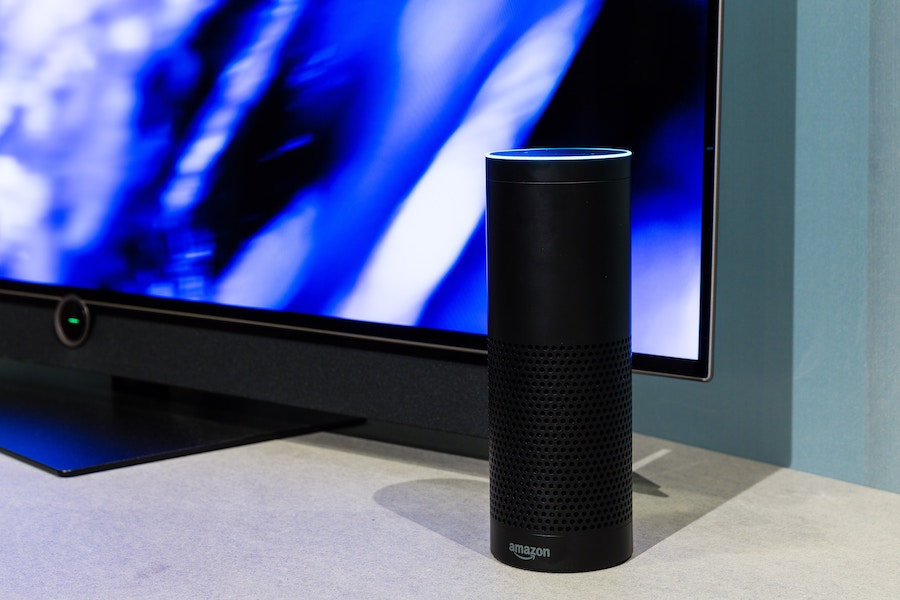
Amazon Echo First Generation. Photo by Loewe Technologies on Unsplash.
Want more information about voice? Great resources:
voicebot.ai - the most comprehensive and updated voice stats and news
The Smart Audio Report from Edison Research and NPR, Spring 2018. (Sample: based upon a national online survey of 909 Americans ages 18+ who indicated that they owned at least one smart speaker)
This Week in Voice Podcast - Bradley Metrock’s show, part of the VoiceFirst.FM podcast network. Bradley and a rotating panel of voice technology experts discuss weekly news relating to voice technology. Get it on iTunes.
Daily news: I talk about voice marketing on The Daily Beetle Moment (daily under three minutes on Alexa Flash Briefing and Google Home)
I have guests on my weekly podcast about marketing, usually focusing on voice: Beetle Moment Marketing Podcast (on iTunes, Stitcher, and Spotify)
This Week in Voice Podcast - Emily Binder with Jason Fields, Voicify (Season 3, Ep. 13)
Emily Binder joined Jason Fields, Chief Strategy Officer at Voicify, and host Bradley Metrock, CEO of Score Publishing and head of VoiceFirst.FM on This Week in Voice.
Stream the episode here or click the image below:

This Week in Voice Podcast: Guests: Emily Binder and Jason Fields (season 3, episode 13) with Bradley Metrock
Listen on your favorite podcast player:
Apple Podcasts (iTunes) - This Week in Voice: Season 3, Episode 13
TuneIn: on your smart speaker, say:
"Alexa, play This Week in Voice."
"Hey Google, play This Week in Voice podcast."
Timestamps and stories (sources linked):
1) 04:15: Amazon's Super Bowl ad, featuring Harrison Ford, is already drawing positive reviews in advance of the big game
Amazon is reassuring us that they can be trusted (PR wake)
“Not everything makes the cut” re: Amazon Alexa hardware
I love this - very Bezos: Queen: “Don’t Stop Me Now” plays at the end
Celebrities and testimonial - well cast, diverse (Harrison Ford, Forest Whitaker, Broad City women, astronauts)
A little creepy
Transparency about product failure - brands can make mistakes (this is the zeitgeist we’re in)
10:35 - Amazon Alexa microwave
Clever psychology
2) 11:48 - Siri Shortcuts can be used to steal and send personal data
Moore’s Law (Jason)
15:45 - another Apple security breach with Facetime Groups - microphone on before call is answered
17:50 - is Apple’s quality decreasing?
3) Voicebot.AI Story of the Week: Walmart pulls out of Google Express and Google Shopping Actions
This is about DATA
4) BBC: Are smart speakers good for kids?
Remember Mattel’s Aristotle, a 2017 Alexa kids smart speaker that never made it to market? Because privacy concerns.
It’s complicated
5) "Can we create a non-patriarchal, unprejudiced, post-gender virtual world?"
What is “post-gender”!?

Marketing and voice tech in under three minutes a day.
On Alexa Flash Briefing and Google Home.