
Definition: What is Voice Marketing?
Voice Marketing is the strategies and tactics used to reach your target audience through audio content and/or voice-enabled devices powered by AI voice assistants such as Amazon Alexa, Google Assistant, and Apple Siri. Podcasts, Flash Briefing, and all branded audio including sonic logos, audio marks, and IVR phone systems are also considered voice marketing.
Voice Marketing definition:
Voice Marketing is the strategies and tactics used to reach your target audience through audio content and/or voice-enabled devices powered by AI voice assistants such as Amazon Alexa, Google Assistant, and Apple Siri.
It includes recorded audio content such as podcasts, Flash Briefing, and all branded audio including sonic logos, audio marks, and IVR phone systems. An evolution of search engine optimization (SEO), voice search optimization (VSO) is an important aspect of Voice Marketing wherein brands, products, and services optimize content to be found through spoken searches.
Why does voice matter for marketing?
We are leaving the Tap, Type, and Swipe era and entering the VoiceFirst era, where computing shifts from physical interactions on handheld devices and keyboards to natural speech.
Stats about Voice Search and Mobile:
Currently, 41% of adults use voice search at least once per day.
30% of searches will be screenless by 2020 (Gartner). Thanks to the growing popularity of hearables and voice devices like Apple AirPods, Echo Buds, Google Home, and Amazon Echo, voice-first interactions will become ubiquitous. (Listen to our podcast with hearables expert Dave Kemp.)
Half of smartphone users engage with voice technology on their device (comScore).
The total voice searching user base among U.S. adults is 42.7% (Voicebot, 2019).

Voice marketing is the strategies and tactics marketers use to reach their audience through AI voice assistants such as Amazon Alexa, often on smart speakers like the Amazon Echo.
Improvements in speech recognition technology have thrust voice search to the forefront of search marketing.
With speech recognition by AI voice assistants at 95%, on par with human speech recognition, NLP (Natural Language Processing) has advanced to the point where people are getting more tasks done through voice. This will only become more common because humans avoid friction in all tasks. Voice is the ultimate convenient mode of interaction, and it can be accessible to people of all ages, backgrounds, and abilities.
Alexa Flash Briefing:
Watch Emily’s video about Alexa Flash Briefing - a great way to get started with voice marketing with a mini podcast (a briefcast) on smart speakers:
Voice Technology Becomes Mainstream:
Voice controlled technology has officially moved out of the early-adopter phase and into the mainstream. Apple's Siri, Amazon Alexa, and Google Assistant have become household names in a few short years, with Amazon Echo as the first mass market smart speaker that went on sale in 2014 with the first generation Echo.
As voice assistants continue to gain traction on smartphones and smart speakers, users will interact through voice more and more, with attention shifting to this medium. Voice will become the new battleground for user attention and it will be a top place to get information, place orders and shop, and consume content.
Marketing Implications - From Screens to Voice:
Attention is moving off screens and to voice. Much like we moved from desktop to smartphones and had to update our strategies and websites to be mobile, we need to think about voice the same way. But for the first time ever, we will not be computing in computerese (typing, text, and the language and interface of the machines). Voice is a unique departure and a true paradigm shift unlike anything before.
You are probably wondering what the return will be on tactics involving voice marketing. These tactics might include building a custom Alexa skill or a Google Action, launching a podcast or Flash Briefing, or investing in sonic branding. Read more here: What is the ROI of Voice Marketing?

Ask an expert.
30 or 50 minutes with Emily Binder.

Best Podcasting Equipment
You can get a quality podcast recording setup for a couple hundred bucks. Here are our simple recommended tools with links to purchase.

Clients getting started with a podcast or Flash Briefing often ask what they should buy. In the last few years, the technology and equipment available to anyone who wants to record and publish audio has improved considerably and prices have dropped.
Sound good, easily.
You can get a quality podcast recording setup for a couple hundred bucks.
This post has the perfect equipment for podcasting beginners or intermediate level. It’s short so you don’t have to wade through reviews and tons of information. Just buy a few of the items we recommend and start recording!
Reach out if you want help with your content strategy or podcast marketing.
(Updated): Best Easy Video Podcasting Setup for Zoom:
Watch Emily’s video showing the best home podcasting setup for video podcasting with Zoom:
Podcast Hosting (RSS Feed and Scheduling Tool):
You will need an affordable podcast host to generate your RSS feed and store your audio files (your episode mp3s). We recommend Acast. You can get a $25 Amazon Gift Card when you sign up from our page. Our clients have been happy using Acast for podcasts and Flash Briefings.
Watch Emily’s interview with Tess Neudeck from Acast: What Podcasters Should Know.
Read the rest: Best Easy Podcasting Equipment – Microphone and More

Amazon's Easy Way to Top Search Results - "Financial Advice" SEO Example - Citywire
Voice search presents a huge opportunity because there is a scarcity of content. Instead of competing with 1.03 billion search results on Google, you can be up against ten on Amazon Alexa (for “financial advice” at least).
Would you rather compete with a billion others or ten? Here’s a stark example of just how blue the ocean of Alexa Skills and voice search is.

Google’s SERP (Search Engine Result Page) has 1.3 billion results for search term “financial advice”.
Search for “financial advice” on Google. There are 1.03 billion search results as of this writing.
Then search on Amazon.com under the “Alexa Skills” department, or under Skills in the Alexa app. There are TEN results.

Amazon.com’s SERP (Search Engine Result Page) for Alexa Skills has 10 results for search term “financial advice”. (The top two results happen to be the skills we built for Ritholtz Wealth Management - case study.)
Press play below for a 2-minute briefing about:
Why it’s easy to rank for your keywords on Amazon Alexa vs Google (SEO for Alexa Skills is a big opportunity)
Flash Briefing is far less competitive than podcasting (and shorter is better for most content)
How to repurpose Flash Briefing beyond just Alexa - it’s a marketing tool
Understand that this applies to almost any industry - not just finance!
EVENT: October 3, 2019: Online event - join me and other Flash Briefing experts at The Voice of the Flash Briefing to learn more (get tickets for the webinar)
Bottom Line about Voice Marketing
Voice is a big opportunity because right now there is a scarcity of content. It was like the early days of the internet when there were only 10,000 web pages. (There are currently about 10,000 Alexa Flash Briefings.)
Amazon is the third largest search engine in the world.
And it’s no longer about just products and ecommerce results. With Alexa providing answers, information, and voice experiences, this is becoming a search engine to compete with Google.

#CitywireRIA
I’ll be presenting this and more cool information about how to use Alexa for marketing your wealth management firm at Citywire RIA on October 2, 2019. See you there!
-Emily

Voice Marketing Success Metrics - Alexa Skills ROI
ROI: How do you measure your voice marketing efforts? Four ways to determine success in the voice space, focusing on Alexa Skills.

Amazon dominates the smart speaker market and is predicted to easily hold onto its top spot through 2021, when nearly 70% of total U.S. smart speaker owners will continue to use an Amazon Echo device. (via eMarketer, 2020)
What metrics should your company or brand look at to determine success in voice marketing? Let’s focus on Alexa first. Beyond the stats available for Alexa Skills (including Flash Briefing) in your Alexa Developer Console, you have ratings (how many reviews, how many stars your skill averages). But what else matters and how do you know your voice marketing efforts are paying off?
First, remember that on an early platform like voice, you won’t see direct ROI as quickly or easily as on more established platforms. That’s fine. You’re not doing voice to increase sales 50% this year. You’re doing voice to get in on the fastest growing consumer technology since the smartphone. You’re here to learn, set your product or service up for longterm success, and avoid falling behind. In two years, everyone else will be playing catch-up.
Why voice analytics are distinctly powerful:
70% of online carts are abandoned. If someone leaves your website without buying anything, you can often only speculate as to what went wrong (or try to learn after the fact, via a survey for example). You can email them coupons to try to lure them back to complete the purchase. And many users are savvy to this automation so the exit the site to simply wait for your “Come back!” coupon email. It’s an ecommerce rat race.
With voice, the customer has literally told you what they’re looking for, even if your voice app (Alexa Skill, Google Action, or Siri) wasn’t able to handle it. You get that human insight. That’s a win.
Voice Marketing Success Metrics
1. If success is defined as Alexa skill use/engagement:
The obvious metrics in Amazon Developer include:
Customers
Plays (for a Flash Briefing)
Sessions
Lifetime enablements
But go further and calculate stickiness. I.e., of total enablements, how many return to use the skill more than once?

Metrics available in Alexa Developer Console - Analytics for custom Skills
Figure out how many people come back vs enable once, use, and forget. Some skills should have higher retention than others; for example, Tide’s Stain Remover should be invoked a few times a year at least, or however often you stain your clothes. Get Urgently’s frictionless roadside assistance Skill may only be used about once a year or less - it would still be successful though. It depends on the functionality and use case.
2. If success is defined as showing up when people search for your brand name, product, category, or service (SEO):
Figure out the top 3-5 essential phrases your customers might use to search for your brand or type of product with voice. Are you showing up based on those voice queries? Example: “Alexa, show me the best running shoes.” (Note - as of this writing, Alexa on the Echo Show 5 shows men’s Nikes no matter the gender of the person who searches. This is a miss because Amazon has the user and shopper data to show a personalized result. That will come.)
3. If success is defined as increased interaction outside voice (multi-channel):
If you have any sort of CTA inside your skill, whether that is to visit a web page or comment on Twitter with a certain hashtag, track it. Use a specific URL or hashtag that you only share on your Alexa skill or announce in your Flash Briefing. Drive customers to your other channels if it’s valuable for them. If your Skill provides appointment booking or location information (such as for a local business) then track how many users found you this way.
4. If success is defined in terms of revenue:
Caveat: revenue as a KPI for voice is a simplistic view that doesn’t account for the value of being early to a new platform. We don’t focus on revenue yet. However, voice commerce is expected to be an $80 billion market by 2023 (via Juniper Research). Hold on.
Incremental sales: what revenue have you driven that you can attribute to voice search or voice commerce?

Marketing Tip: how to promote your Alexa Skill or voice experience
When you run surveys in your general marketing practice, whether those are on a sales receipt, a website pop-up / survey form (“How did we do?”), or a thank-you email post-purchase, include a question or two about whether your customers are aware of and have used your Alexa skill.
5. If success is defined as insight that will inform your strategy:
Look at Alexa as a way to learn from your customers - what do they ask? What do they try to accomplish? Use Amazon Developer to begin understanding what users want and like based on utterances. If you gain insight, that is success. Consider:

What is the ROI of voice marketing? It’s hearing what your customers want in real time. Click here to retweet this image
How many utterances users make in a typical session with your Skill?
What percentage of user interactions with your Skill result in a successful outcome?
Which of your Skills’ capabilities are being used the most and the least? What does that tell you?
Cohort analysis: see whether people acquired during a given month (e.g., after you launched a new feature) behave differently than those who joined prior
Retail: See where in the sales path customers are having to ask for help (note: transcripts aren’t available for voice assistants like Alexa at this point, but you can still identify friction points by volume of questions and the answers your skill is called on to give).
Want more?
Get short daily tips and insights on voice marketing:
A) On Alexa Flash Briefing (enable here then say “Alexa, news”)
B) Stream in your favorite podcast app:

1 Link to Share Your Podcast Everywhere: Plink Smart Link - Social Media
Grow your podcast audience. Send listeners to the right place every time. Your podcast already has a free Plink that opens your show in the listener's podcast app. Best for social media to simplify sharing.
What is the number one mistake podcasters make when sharing their show on social media? Emily Binder breaks it down in this 60-second video and shares the solution we recommend:
Want to reach a larger audience?
Over 55% of U.S. adults have listened to a podcast. What’s stopping the rest?
48% of people who don’t listen to podcasts say it’s because they’re “not sure how to listen.”
Of the people who don't listen to podcasts, 80% (wrongly) think they "don't have a podcast app on their phone” (via Edison Research).
In reality, iPhone and Android phones have a native podcast app. And all smartphones can play podcasts from a mobile browser. So reassure your social media audience that they can indeed access your podcast with one simple link. Remove any perceived friction from both seasoned podcast listeners and newbies.
Podcast hosts:
You know the moment of uncertainty when it comes time to share a new episode on social. Do you share the Apple link, the podcast’s home page/show notes with the web player, Spotify, SoundCloud, all of it, or what?
If you tweet an Apple Podcasts link, you could miss your entire Android audience.
We’ve all seen single tweets containing multiple links to play a podcast in Apple AKA iTunes, Google Play, Stitcher, and more. Those posts are messy and violate one of the rules of marketing:
Simplify your CTA (call to action).
There is an easy solution: Plink.
What you want is a nice clean social post with ONE link. Don’t confuse your audience and make them figure out what to click.
This is what Emily Binder suggests to clients. We use it to share our podcast and Flash Briefing.
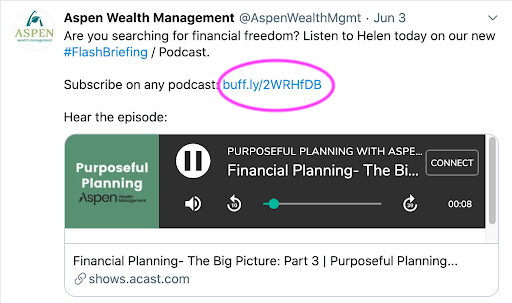
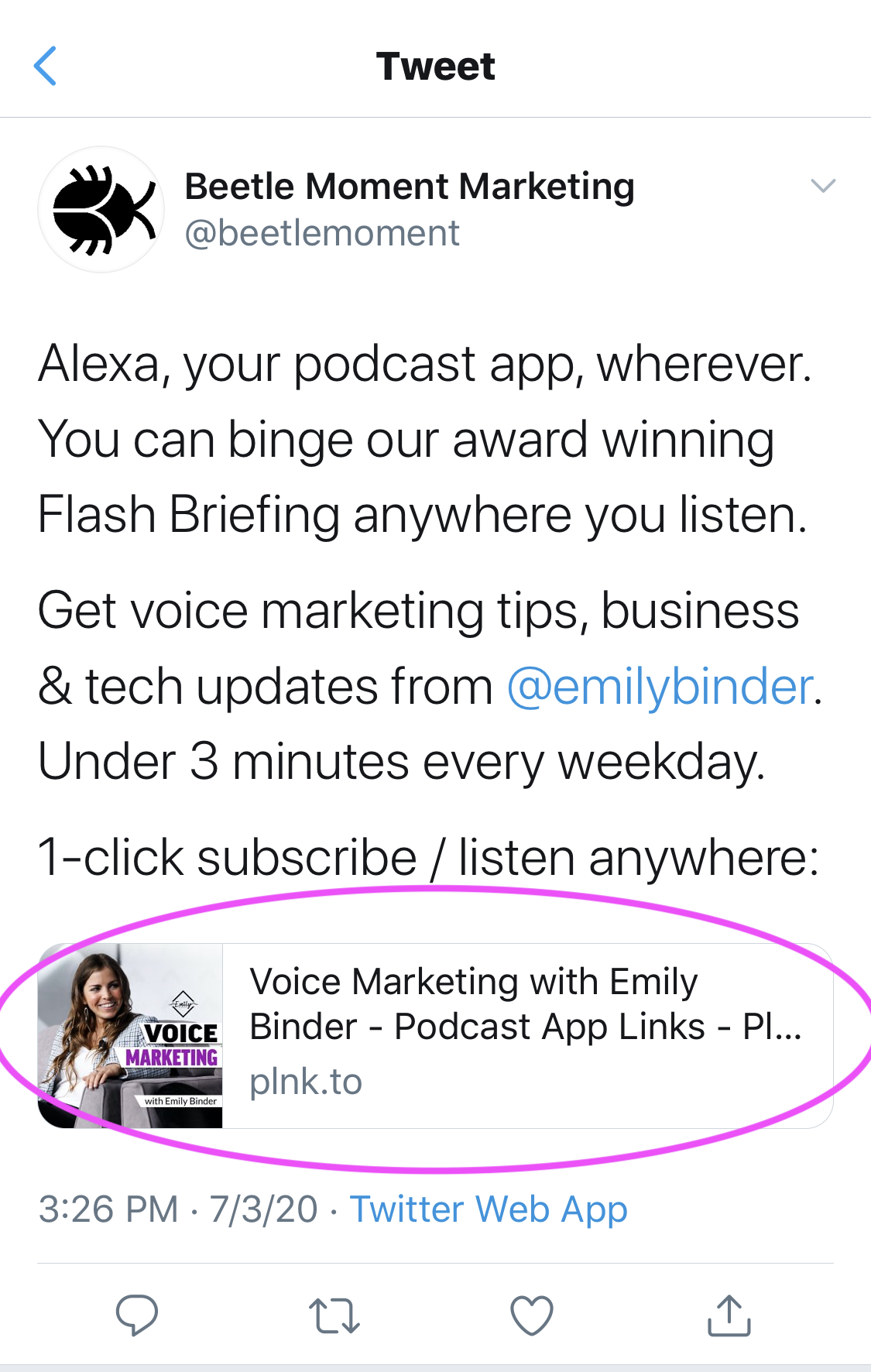
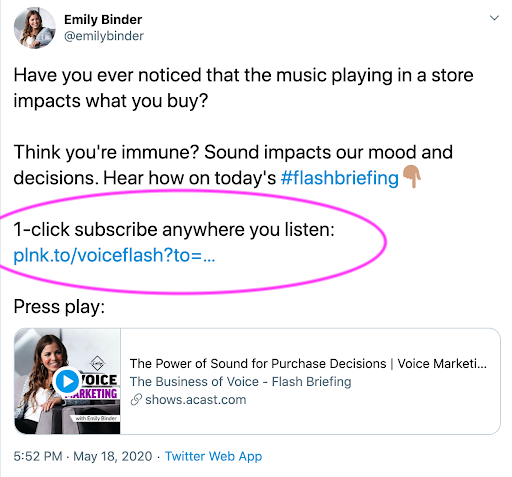
Example tweets using Plink (circled in pink), scroll right below:
Plink universal podcast links
Plink makes smart links that automatically open the right podcast app on mobile, or present links to all the major podcast apps (AKA podcatchers).
Plink makes smart links for podcasts that everyone can play.
Podcast + link = plink
Click “More” in the Plink widget below to see all the additional podcast app options including Overcast, Castbox, Stitcher, Soundcloud, Pocket Casts, and more. Individual episodes also have their own Plinks:

Plink links send listeners to the right place, every time. Whether that’s from iOS, Android, a laptop, a watch, or a messaging app. Plink recognizes devices/OS then deep links listeners into pre-installed podcast apps if opening a Plink link on mobile. If opening on desktop, it sends the listener to the podcast’s Show Page with app links for Apple Podcasts, Google Podcasts, Spotify, Overcast, Breaker, and more.
Cost:
For $39/year you can create your customized podcast smart link with bonus features. Otherwise the service is free. Features with the paid version:
Custom, short link
$39/yr - plnk.to domain
Everything else included in Free, plus:
Custom, short branded link (plnk.to/yourshow)
Remove "Powered by Plink" branding
Add your iTunes Affiliate ID (optional)
Add/Edit/Customize pod apps URLs
Customize Show Pages & Embeds
Increased visibility - search indexing (helps podcast SEO)
Dedicated support specialist
List 100 latest episodes links
Link analytics
The paid version/upgrade is affordable at under twenty dollars for the year, and looks more professional too. For example, here are vanity URLs from two popular podcasts:
Barry Ritholtz - Masters in Business: https://plnk.to/MIB (see our case study on launching v1 of The Compound Show with Ritholtz Wealth Management CEO, Josh Brown)
This American Life: https://plnk.to/thisamerlife
More benefits of Plink:

This is what our Plink podcast landing page looks like. All the major podcast apps on a neat menu with individual episodes, too.
A podcast app menu widget with an easy embed code for your blog
How to get it: click “Share” from the show’s Plink page, then copy and paste the code as Markup / HTML on your website. It will look the the Beetle Moment Marketing Podcast menu you see here.
Ability to send users to a specific podcast app (a feature with the paid plan):
Plink smart links, without any parameters added (params outlined below), will detect the listener’s device, geo, and other factors and send them to your show in pre-installed podcast apps like Apple or Google Podcasts automatically. This is a link that anyone can play, no matter their device or OS. It works on iOS, Android, desktop, etc. (That is the first link below). Or you can utilize other variations that you now own, too (links are case-sensitive):
plnk.to/beetlepod?to=page (to always send to the Show Page menu - where desktop/laptop users are sent regardless. Use this link if you want mobile users to see the menu instead of automatically opening in their app such as Apple Podcasts)
plnk.to/beetlepod?to=embed (for website Embeds on your own site - iframe code snippets are found at bottom of Show Pages)
plnk.to/beetlepod?to=applepod (to always send to Apple Podcasts if needed for some reason (e.g.. exclusives))
http://plnk.to/beetlepod?to=googlepod (to always send to Google Podcasts)
http://plnk.to/beetlepod?to=spotify (to always send to Spotify)
Reminds me of…

75% of Americans are Now Familiar with Podcasting: This is approximately 212 million people and an increase of more than 10 million in one year. (Infinite Dial 20)
Have you used the music sharing app Songwhip? It lets you share a universal link (instead of a link to a song on Spotify or YouTube etc.). This way, friends can open the song you share on their music streaming player of choice: Spotify, Apple Music, Google Play, Pandora, etc.
Feeling musical? Here are some Songwhip link examples - click to play on your favorite music app:
Plink is offering something similar to Songwhip, but for podcasts. Make sense? Yeah!
Find any podcast’s Plink here to check it out.
This is the closest thing we’ve seen to a solution for the common problem that sharing your podcast is a major PITA.
To be thorough, here are a couple alternatives to Plink:
1) You can use smart.url, a subscription service, to accomplish the same thing:
Smart & powerful. One link that redirects by country and device. smartURL combines all the features previously found in Country, Device and Music types.
2) Playpodca.st offers a smart link for a one time charge of $25:
Get a playpodca.st shortcut to your show today, and you will have a link that takes your listeners to a native podcast player, no matter whether they are clicking from iOS, Android, Windows or Mac.
Desired: All Plink needs is to integrate with Alexa Flash Briefing. We hear this feature is coming soon. For example, our Flash Briefing, Voice Marketing with Emily Binder is available on the major podcast apps. But we’d like to have Alexa Flash Briefing as one of the assorted podcast app options on the Plink page.

Monthly Podcast Listeners Have Grown 54% in 3 Years: In 2017, 24% of Americans 12 or older listened to podcasts monthly, compared to 37% in 2020. (Infinite Dial 20)
Bottom line:
Shortlinks like Plink make marketing podcasts easier. Hosts and producers can promote a show with one, smart link. Learn more and find your show’s Plink smart link: plinkhq.com
This post is not sponsored. But if you sign up with our link we’ll get a small referral fee which helps pay for hosting the podcast and blog. Our goal is to share knowledge that will help podcasters stop tweeting out a mess of links. :)
This post was updated March 2021 to provide the latest stats and links.

10 Best Podcast Episodes: Voice Marketing and #VoiceFirst Technology (Part 1)
Looking for great podcasts about voice technology? Here are some of our favorite episodes

Looking for great podcasts about voice technology? Here are some of our favorite episodes that aired in roughly the last six months. Get notified via email when we publish Part 2.
Download these for offline listening for your next flight or road trip to hear a nice overview of voice technology, voice marketing, speech recognition, Alexa Flash Briefing, podcasting, smart speakers and voice assistants, and the future of voice-first interfaces and computing. #Voicefirst baby.
For anyone new to voice or even if you’re familiar but want to learn more - this list is for you. In no particular order:
Podcast Episodes about Voice Marketing and Technology that You Need to Hear:
The Last Interface with Brian Roemmele on Voice First Health ep. 27 with Teri Fisher.
About: The future of Voice: The Last Interface, the Intelligence Amplifier and the Wisdom Keeper. (February 19, 2019)Be Here First: The Future of Voice-Interface Marketing on The Marketing Agency Leadership Podcast - Emily Binder with host Rob Kischuk. (May 16, 2019)
About: Voice search, voice SEO, brands must play in Alexa's ecosystem, the power of Flash Briefing and tips for a good one.Podcasts of the Future – Bryan Colligan, AlphaVoice – Voice Tech Podcast ep. 010 with host Carl Robinson.
About: Bryan Colligan is the co-founder of AlphaVoice, the easiest way to get your podcast and audio content onto Amazon Alexa and Google Assistant. Bryan shares his vision of how the podcasting and voice technology worlds are set to collide, and how the implications will be felt by platforms, content producers and consumers alike.Voice Strategy with Emily Binder of Beetle Moment Marketing on Alexa in Canada with Teri Fisher. (February 26, 2019)
About: The power of voice marketing, what sonic branding means, and why Flash Briefings are such an incredible opportunity when it comes to getting a brand’s voice heard in the voice-first world.Heidi Culbertson CEO of Marvee on Voice and the Elder Community – Voicebot Podcast Ep. 68 with host Bret Kinsella. (November 5, 2018)
About: Culbertson discusses voice UX principles and how requirements must be modified when serving older users. She also discusses the Marvee Alexa skill, what the team has learned about elder users and why they are changing the skill significantly to better align with user needs. Heidi is a former professional tennis player and a cool and interesting lady. We polled several people to recommend episodes featuring women and nearly all mentioned this episode.This Week in Voice: Season 3, Episode 13 - Emily Binder and Voicify’s Jason Fields with host Bradley Metrock.
Topics: Amazon's Super Bowl Ad, Siri Shortcuts, Walmart pulling out of Google Express, and whether or not smart speakers are good for kids, and gender and bias in voice design. (January 31, 2019)What to Know about Voice AI w/ Katie McMahon at SoundHound - DataTalk podcast with host Mike Delgado.
About: Touch, Type, and Swipe era is giving way to #VoiceFirst.Top Five Tips for a Great Flash Briefing - Daniel Hill from The Instagram Stories Flash Briefing on Beetle Moment Marketing Podcast ep. 33 with host Emily Binder. (April 28, 2019)
a16z Podcast: Talent, Tech Trends, and Culture with Marc Andreessen, Ben Horowitz, and Tyler Cowen (this is not 100% focused on voice but Andreessen’s points about technology and innovation definitely apply. He says the big box store is going away, which obviously relates to voice enabled shopping. (December 29, 2018)
This Week in Voice: Season 3, Episode 9: Brian Roemmele with host Bradley Metrock (November 15, 2018)
About: The current state of #VoiceFirst technology and what stories were top-of-mind in 2018. Brian is called The Oracle of Voice for a reason, so we consider this evergreen.
A note about representation: we want to feature more women hosts or solo guests. If you have any suggestions, please comment or tweet us @beetlemoment and we’ll review the episode to potentially be included in Part 2. Thanks!

How to Grow Your Alexa Flash Briefing Audience
You’ve published your Alexa Flash Briefing, and you understand why voice is important.
Good move: smart speakers are the fastest growing consumer technology since the smartphone, and Amazon has market share.

Amazon Echo Dot was Amazon’s best-selling product site-wide, across any category during the 2017 holiday season. (Source: Slate) Photo by Andres Urena on Unsplash
Before you start any of the below tactics, benchmark where you are now - what gets measured gets managed.
Record how many listeners you have using the Amazon Developer measure tool.
Then track the increase you’ll see over the next month as you implement these steps.
Read on for the best ways to grow your Alexa Flash Briefing audience.
Alexa Flash Briefing Terminology
Alexa: Amazon’s virtual voice assistant which powers millions of devices like the Echo family of devices.
Skill: Like apps on your phone, Alexa provides skills enabling customers to create a personalized experience. Skills provide weather, traffic, news, trivia, cooking, exercises, etc. There are now thousands of skills from companies and organizations like Domino’s, Starbucks, NPR, and Uber and individual creators (like you).
Flash Briefing: A quick overview of news and other content such as business or financial advice, music, comedy, podcasts, and sports. Customers hear their Flash Briefing by asking their Alexa-enabled device, “Alexa, Flash Briefing” or “Alexa, tell me the news.” Flash Briefing comprises at least one Flash Briefing skill.
Flash Briefing Skill: This is a type of skill. It provides content for a customer’s Flash Briefing (typically composed of several Flash Briefing skills). Anyone can create a Flash Briefing skill. In this post, I often refer to a “Flash Briefing” to mean your particular briefing (AKA skill) because this is how most people talk about it.
So, how do you get people to listen to your Alexa Flash Briefing?
Cadence and Content
Publish your Alexa Flash Briefing daily. Amazon wants more content. If you only publish weekly, that’s okay, but aim for daily if possible. (You could always reduce the frequency later, or split the baby and update three times per week.)
Tip: Batch recording sessions. Come up with fifteen content ideas, then record them in one sitting. Batching is an effective way to be more productive because it lets you avoid task switching costs.
Publish at peak times. Morning is key here because most listen before starting their day (it’s a routine). Publish around 4 AM ET (use tools such as Effct, SoundUp, or Storyline to automate this).
Keep it under two minutes. This is the listener sweet spot. Not only will they appreciate brevity and listen all the way through, but it’s also likely Amazon will reward briefs whose listeners don’t skip ahead or become bored and exit. (Much like YouTube rewards videos with the most watched minutes and those that keep users on the platform longer.)
Optimize Your Skill Title and Keywords
Just like a product listing on Amazon, take advantage of every field on your Alexa Flash Briefing skill’s page (it’s essentially a product detail page as far as Amazon SEO is concerned).
Title – Name your skill with a short, clear name that tells users what it is and contains at least one top search term. For example, if your brief is about local news, the title should contain your city name. This is almost better than containing “news” because you may appear in search results for anything related to your city – not just “news”, which is much more competitive.
Keywords – You can select up to thirty single words as your descriptive keywords. These and your description are important real estate. Do some keyword research and include terms that people search for related to your content or industry. If you’re lazy, type the first few words of a typical search query into Google and look at the suggestions that appear.
Share Your Skill on Social Media
Sharing on social has the best ongoing effort-to-reward ratio (it doesn’t take much time and can reach lots of people). Try it two ways:
Share with your social network (existing connections).
Write five different social posts that promote and link to your skill. Schedule them in advance with a tool like Buffer or Hootsuite. Don’t overpost, maybe 1-2 times per week on Facebook, Twitter, LinkedIn, and Google Plus. For Pinterest, pin once to the keyword-rich board(s).
Track post-performance. Determine which posts receive the most engagement (e.g., Twitter shows each tweet’s impressions and engagements). Keep top performing posts, reschedule them, and continually iterate by tweaking words and length to find the most effective language.
Entice. When you publish new Flash Briefings, post teasers on social. Create curiosity! For example, here is a post which creates curiosity and provides clear instruction:
“Tune into today’s Flash Briefing to hear about the greatest marketing trick of the century. How to listen: 1) Enable the Skill here: [LINK TO SKILL]. 2) Say “Alexa, what’s my Flash Briefing? on your Echo or in your Amazon app.”

Any smartphone can become an Alexa device and play Flash Briefing – no Echo needed. Source: Emily Binder, iPhone screenshot
And that last part: yes, bonus! Users don’t need an Echo to hear your brief.
Anyone can turn their phone into an Echo device by downloading the Amazon shopping app.
The circle in the top right of the app activates Alexa. Try it!
(Smart move, Amazon - now everyone with the shopping app has Alexa, Echo or not.)
Join and Share with Interest Groups
Reddit hosts communities with people who have an interest in Amazon Alexa and Echo.
Publicize your skill in a few of the top groups.
But remember, don’t just self-promote.
First, help others. Try their skills then leave reviews on Amazon.
Interact, introduce yourself, and ask people to enable your skill and provide feedback.
Here are some general Echo and Alexa groups on reddit:
https://www.reddit.com/r/Alexa_Skills/
https://www.reddit.com/r/amazonecho/
https://www.reddit.com/r/alexa/
Find niche groups based on your topic. For example, if you focus on meditation, you could hang out here.
Look for similar interest groups on Facebook. Then rinse and repeat.
Make it Easy to Share
Create a shortlink to your Alexa Flash Briefing Skill (use bit.ly, Googl, or a custom-branded one, which is even better). Try Plink for an automatic 1-click podcast listen experience (if your briefing is available on podcast platforms like Apple Podcasts and Stitcher).
Do this immediately to reserve the shortest and clearest custom link.
Make the shortlink easy to read using words that easily separate. Make it easy to type and use all lower case (shortlinks are case sensitive). For example, mine is bit.ly/beetleflash (for Beetle Moment Flash Briefing).
You can then easily share the shortlink:
In your social bios (i.e.-Instagram, Twitter, and your email signature)
You can do this verbally if you plug yourself on a podcast or other interview. Save new listeners from searching – make enabling your skill a one-step shortlink process.
Share Archived Briefs
Use the same formula from above and give people an accessible, easy way to hear your content anytime.
Copy any MP3 URLs from your past briefs and add to blog posts with clear titles and ideally a bit of introductory text.
Ratings and Reviews
The faster, the better.
Begin to rank for your keywords before the Alexa ecosystem becomes more crowded.
Join a Facebook group related to Flash Briefings. If you want to join our private #FlashBriefing Slack channel, contact Emily and send a link to your briefing.
Or use reddit groups to connect with others who might review you.
We all operate on the reciprocity norm.
Leave reviews for new contacts from these groups or fellow creators you’ve found on Twitter.
It’s easy to reach out to almost anyone through Twitter or LinkedIn.
If you enjoy a briefing, tweet the creator and let them know. That puts you on their radar, and they’ll be more likely to return the favor after seeing your review.
Archive and host past briefings on your website or blog. I recommend Pippa to make embedding audio on blogs and social easy. (Get a $25 Amazon Gift Card when you sign up for a year of Pippa hosting for your Flash Briefing or podcast here.)
Benefits of doing this:
SEO
An evergreen place to send people to hear your content
Your hard work won’t disappear
A convenient way to entice reviews. End with a CTA like this: “Please rate and review so others can find this skill! [LINK TO SKILL]
Have a page of your website called Alexa Flash Briefing and post each brief or a handful of your best ones.
For example, here’s my Alexa Flash Briefing page with some of my favorite briefs.
If you publish daily, this could get cumbersome, so feature the top ten.
Put a big clear button or link to “Enable this Flash Briefing Skill” at the top and bottom of the post(s).
Use your skill icon, make it clickable to your Amazon skill or your episode archive like mine below, and you’ll be on your way to showcasing your Alexa Flash Briefings and gaining a wider audience.

This post originally appeared at spinsucks.com in August 2018. It was updated for this blog in May 2019.

Sonic Branding: Facebook and Instagram's Huge Miss
Do you know what Venmo is doing right with sound in their app? Facebook and Instagram have some catching up to do. Press play for this 1-minute Flash Briefing:
On Alexa
Never miss a daily briefing about voice marketing and more!
Subscribe free to Beetle Moment Marketing on Alexa:
Say, “Alexa, Flash Briefing.”
On Google:
Don’t have Alexa? Get Daily Beetle Moment on Google Home (Google Play Music) here.
Transcript:
🔊 SOUND ON 🔊
1
00:00:02.506 --> 00:00:06.806
Facebook has no sound. Instagram has no sound of their brand.
2
00:00:07.126 --> 00:00:08.426
This is a huge miss.
3
00:00:08.766 --> 00:00:14.752
There should be an audio mark that plays when certain things happen or even at least when you open the app. Let's talk
4
00:00:14.803 --> 00:00:17.566
about just Instagram for a second. If you think about Venmo:
5
00:00:18.306 --> 00:00:24.375
There's a cash register cha-ching sound when you receive money. And you actually have a physical reaction to that where you get a
6
00:00:24.425 --> 00:00:28.306
little dopamine rush, you feel good, it's a positive sensation - good association - with
7
00:00:28.626 --> 00:00:29.026
money.
8
00:00:29.766 --> 00:00:30.266
Facebook and Instagram
9
00:00:31.106 --> 00:00:38.070
have a lot of things going on in our body, a lot of reactions in our brain, major hormonal and neurotransmitter shifts
10
00:00:38.131 --> 00:00:44.006
happening as we scroll and like and see comments and get those emotional strokes (ego strokes).
11
00:00:44.686 --> 00:00:48.286
But there's no sound to it. Huge miss.